
Strip vs. Blister Packaging: Which One Actually Fits Your Product?

Updated: Oct 1

Every tablet or capsule requires a primary pack, and for most oral solid dose products, that choice comes down to two formats: strip packaging or blister packaging. The two are often used interchangeably in conversation, but they are built around fundamentally different manufacturing processes, each with distinct strengths depending on the product.
Both formats have been pharmaceutical packaging staples for a long time. Strip packs date back to the late 1920s, beginning with the single Aspro strip in waxed paper, while blister packs emerged in the early 1960s (Dean, Evans & Hall, 2000). Decades later, both remain in daily use across the industry, and the two are still routinely conflated despite being built on different forming principles.
This article outlines what actually distinguishes the two formats, and the factors worth weighing before choosing between them.
What is the Difference between Strip and Blister Packaging?
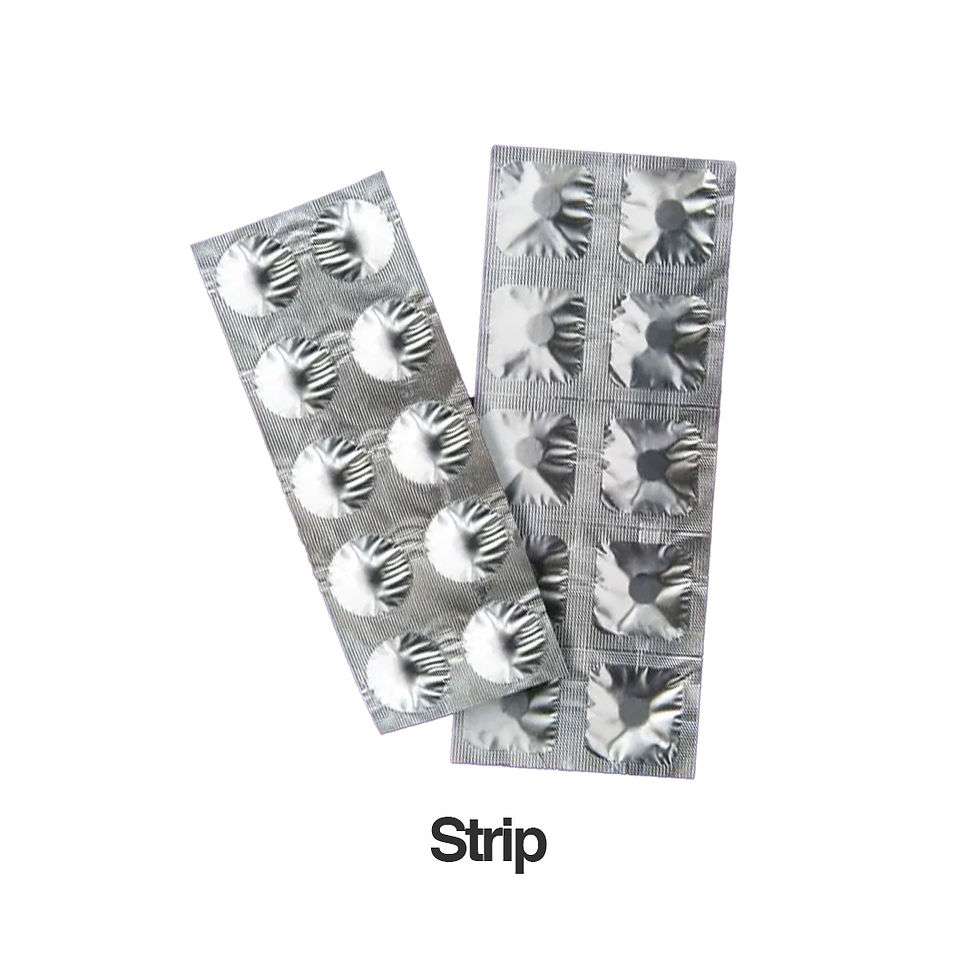
Strip packaging has no separately pre-formed cavity. The product is sealed between two webs of foil or laminate using either a heated reciprocating platen or a heated crimping roller, and a pocket forms around the product during this sealing step. The finished pack is accordingly not flat wherever it contains a tablet or capsule, only the sealed margins between doses remain flat.
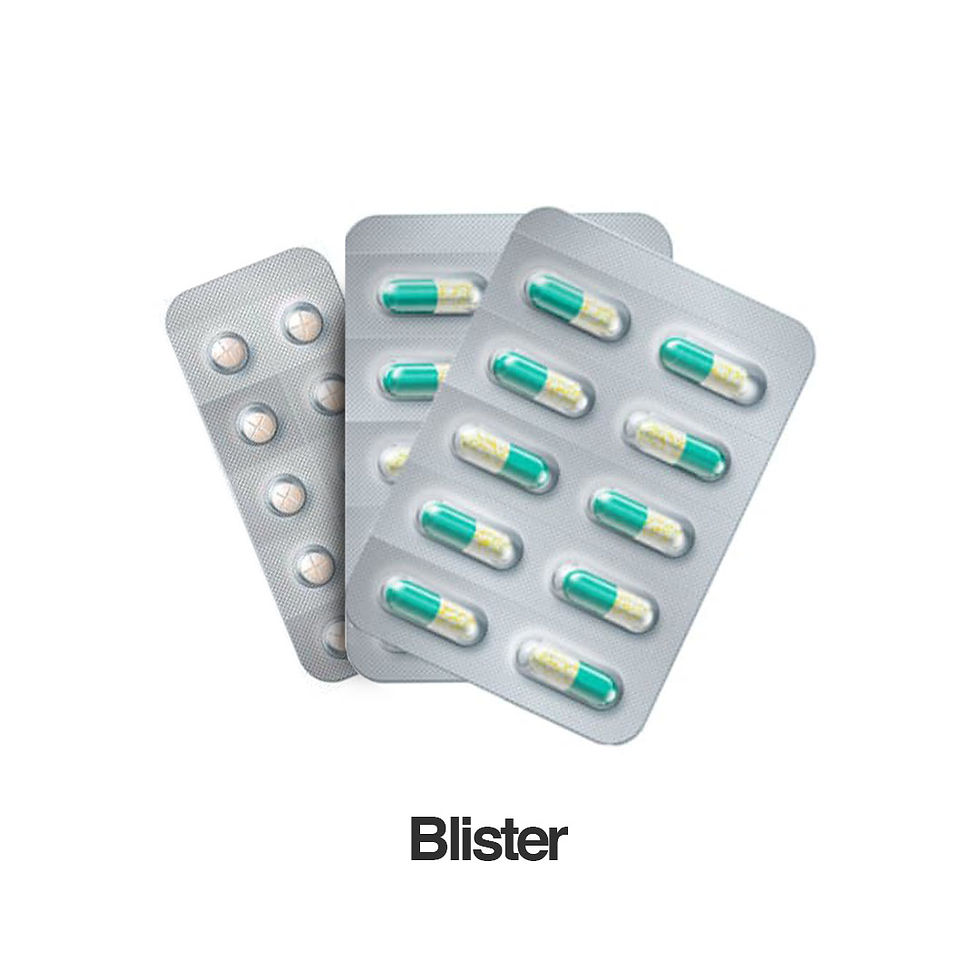
Blister packaging begins with a cavity that can be formed in one of two ways: thermoformed from a plastic film such as PVC, or cold-formed from an aluminium-based laminate, commonly known as Alu-Alu. The cavity is filled with the product and then sealed with a lidding material, typically aluminium foil or paperboard. Because cold-formed Alu-Alu cavities are opaque, blister packaging is not necessarily clear, and PVC is not the only material used to form it.
Aluminium is a common material in both formats, but its presence is not a defining feature of either. Strip packaging may use foil, paper-polyethylene laminate, or other flexible materials, and blister packaging may use a paperboard backing in place of foil lidding. The two formats are more accurately defined by their construction and forming process, not by whether aluminium is present.
Choosing Between Them: Six Factors That Actually Matter
1. Visibility and shelf appeal
Visibility depends on the specific material used within each format rather than on the format itself. A clear, thermoformed PVC blister allows the product to be seen directly, which supports retail shelf appeal and allows patients to visually confirm the remaining dose count. An Alu-Alu blister or an opaque plastic blister does not offer this advantage, despite also being a blister pack. Foil-based strip packaging is opaque, but this follows from the material used, not from any inherent property of the strip format.
2. Barrier protection against moisture, light, and oxygen
Barrier performance depends on the materials used, their thickness, the quality of the forming process, and the integrity of the final seal. It is not adequately explained by the amount of air trapped inside the pack at the time of sealing. Trapped air describes the initial headspace condition within a pocket, which is a separate matter from the pack's ongoing resistance to moisture or oxygen ingress over its shelf life, and it has no bearing on light protection, which depends entirely on the opacity of the material used.
A standard PVC blister generally offers weaker inherent protection against moisture and oxygen than a foil-based strip pack or an Alu-Alu blister, but this is a consequence of material selection rather than the amount of trapped air. For products that are highly sensitive to moisture or oxygen, Alu-Alu blister construction can close much of this gap while retaining the blister's molded-cavity format.
3. Production cost and speed
Blister packaging requires thermoforming tooling, which increases upfront equipment cost and mold complexity. Strip packaging is mechanically simpler and generally requires a lower tooling investment. However, it is not accurate to generalize that blister equipment runs faster or that strip equipment is inherently cheaper and slower as a universal rule — these comparisons depend on the specific machines, materials, pack layouts, and production outputs involved.
Strip equipment can achieve very high throughput: the STV Machine SP-420, for instance, operates across up to fourteen lanes with tablet speeds of up to 300 units per lane per minute, depending on tablet size. Any cost or speed comparison between the two formats should reference the specific equipment under consideration rather than treating one format as categorically faster or cheaper than the other.
4. Space efficiency
The space a pack occupies per dose depends on product dimensions, cavity geometry, seal widths, material selection, and overall layout. It is not accurate to state that one format always occupies less space than the other as a general rule. Strip packaging has no pre-formed cavity, which commonly results in a larger flat footprint around each dose to accommodate the seal area, while a blister's molded cavity can compact that footprint more efficiently in some designs.
5. Ease of opening
Opening mechanisms vary within both formats rather than following a single rule for each. Blister packs may be push-through, peel-open, or peel-push, and strip packs may be tear-open, peelable, or specially designed as push-through packs. Perforations in either format can also separate individual doses without opening the product pocket itself.
Consequently, it is inaccurate to state that blister packs are simply pushed through while strip packs must be separated and peeled open — both formats offer a range of opening mechanisms, and the specific construction determines the force and dexterity required, not the format category.
6. Best-fit product types
Product suitability depends on several interacting factors, including product dimensions, feeding behavior, fragility, sealing-tool geometry, and laminate formability, and product trials are often necessary to confirm suitability before full-scale production.
Effervescent tablets are frequently packaged in strip format, but this is driven primarily by their moisture sensitivity and handling requirements rather than by their shape. Effervescent tablets typically have straightforward, round geometry that would fit a standard blister cavity without difficulty; the reason strip packaging is preferred is that it offers stronger protection against the moisture that effervescent formulations are especially sensitive to.
Powder products require separate consideration entirely. A standard tablet or capsule strip machine, such as the SP-420, is not generally configured to package loose powder. Powder typically requires a dedicated dosing system paired with a sachet, stick-pack, or pouch configuration, which falls into a different equipment and packaging category from the tablet and capsule strip packaging discussed in this article.
Blister packaging remains well suited to standard tablets and capsules where shelf visibility and structured dosing tracking, such as day-of-week blister cards, add practical value.
Learn More
Find high-quality Strip and Blister Packaging Machines made by STV Machine here.
To learn more about strip or blister packaging machines, contact the Jayapak Team:
Email: sales@jayapak.com
LinkedIn: https://www.linkedin.com/company/pt-jayapak-sinar-abadi
Website: www.jayapak.com


